• Skip to main content
  • Skip to secondary menu
  • Skip to primary sidebar
  • Skip to footer

mkpeReport

top analysis covering digital cinema, 3-D, HFR, and laser illumination

  • Reports
  • About
  • mkpe.com
  • cinepedia.com

Is Film Set to Cutoff Imminently?

February 2011 by Michael Karagosian

In the US, it is rumored that only digital distribution will be available in a few years. There’s reason to think that, and reason to not think that. This report will look at both.

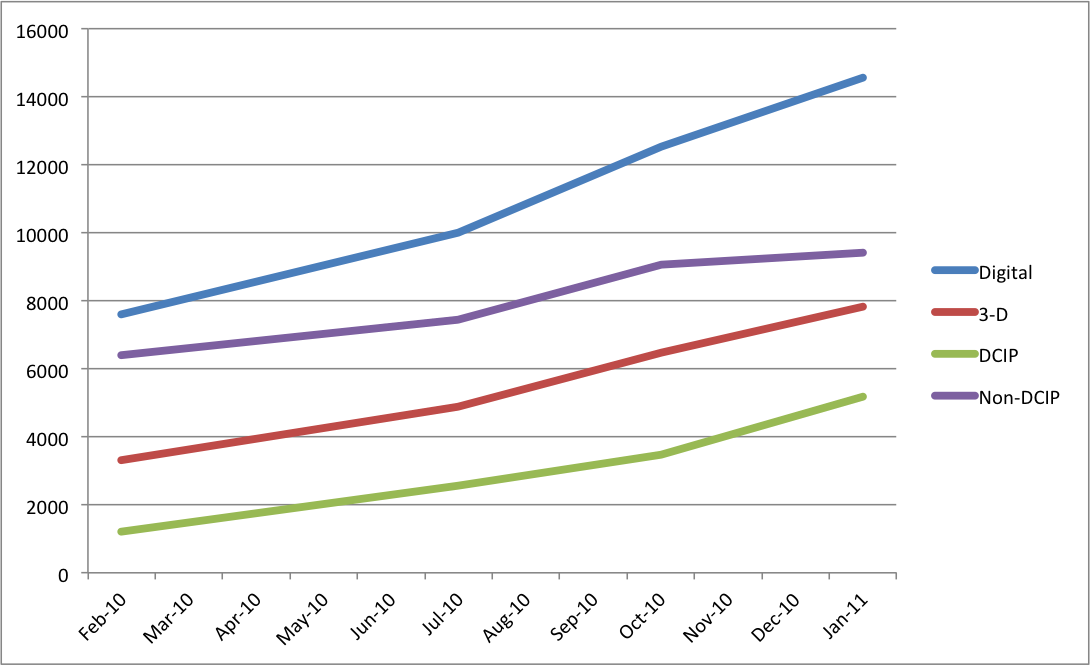
In our December report, we predicted that the US will have 50% of its screens converted by 2012. That’s not a hard prediction to make. Over the past 18 months, about 70% of US installations were that of DCIP. To participate in 3-D box office, DCIP was rolling out digital projectors even before its financing was turned on, with early exhibitor-paid systems rolled into DCIP as collateral for the full rollout. Its rollout should be complete by end of 2012, which by itself should bring the US digital screen total up to 25,000. The graph below illustrates the DCIP growth rate against other interesting factors, including the growth of non-DCIP screens.
2011-jan-dcip-growth-sm

Non-DCIP growth was around 1800 screens in 2010, most all of which were installed under a VPF finance plan. The VPF rollout periods for these plans will expire in 2012. If their rate of installation continues, up to another 3000 screens will be added. Once these VPF rollout periods end, the installation rate will fall. There are other VPF deals in the hopper, but none have all studios on-board nor have resulted in new installations. Altogether, it seems reasonable to expect 28,000 digital screens in the US by the end of 2012.

Some say the US will achieve 30,000 screens in 2013, and that will be the trigger point for cutoff. 30,000 is an achievable number, but not in 2013 once DCIP completes and if VPF financing dries up. Also, 30,000 screens comprise only 75% of the US screen count. It doesn’t seem likely that the remaining 25% will be thrown out-of-business if there’s still an opportunity on the table to profit from box office, even after film print costs rise.

However, it seems like a sure bet that film won’t survive the expiration of the VPF payment term. At that point, the cost of digital print delivery drops dramatically. If that ceiling occurs around the year 2020, then somewhere between 2013 and 2020 film will actually cutoff. Probably not 2013, but also probably not 2020. Those who like to gamble have a narrow range in which to pick their date.

Filed Under: Deployment Entities, Exhibitors

Primary Sidebar

Search

Topics

  • 3-D
  • Accessibility
  • Alt Content & Advertising
  • Anti-Piracy
  • Color
  • Communications
  • Deployment Entities
  • Distributors
  • Exhibitors
  • Fulfillment
  • High Dynamic Range
  • Higher Frame Rates
  • Installations
  • Patents
  • Projectors
  • Servers and IMBs
  • Sound
  • Technical Bodies
  • Theatre Management Systems
  • Trade Organizations and Shows

Full Archives

a publication of
MKPE Consulting LLC

Footer

Important Stuff

  • About
  • Privacy Policy

Archives

  • Category & Monthly Archives
Archives date back to 2008.

MKPE

mkpeReport is a publication of MKPE, a world-class consultancy building business at the crossroads of cinema and technology.
Learn more about MKPE.

copyright © 2008 - 2026 mkpe consulting llc

Manage Consent
To provide the best experiences, we use technologies like cookies to store and/or access device information. Consenting to these technologies will allow us to process data such as browsing behavior or unique IDs on this site. Not consenting or withdrawing consent, may adversely affect certain features and functions.
Functional Always active
The technical storage or access is strictly necessary for the legitimate purpose of enabling the use of a specific service explicitly requested by the subscriber or user, or for the sole purpose of carrying out the transmission of a communication over an electronic communications network.
Preferences
The technical storage or access is necessary for the legitimate purpose of storing preferences that are not requested by the subscriber or user.
Statistics
The technical storage or access that is used exclusively for statistical purposes. The technical storage or access that is used exclusively for anonymous statistical purposes. Without a subpoena, voluntary compliance on the part of your Internet Service Provider, or additional records from a third party, information stored or retrieved for this purpose alone cannot usually be used to identify you.
Marketing
The technical storage or access is required to create user profiles to send advertising, or to track the user on a website or across several websites for similar marketing purposes.
  • Manage options
  • Manage services
  • Manage {vendor_count} vendors
  • Read more about these purposes
View preferences
  • {title}
  • {title}
  • {title}