• Skip to main content
  • Skip to secondary menu
  • Skip to primary sidebar
  • Skip to footer

mkpeReport

top analysis covering digital cinema, 3-D, HFR, and laser illumination

  • Reports
  • About
  • mkpe.com
  • cinepedia.com

Cutting the Cost of Illumination

June 2012 by Michael Karagosian

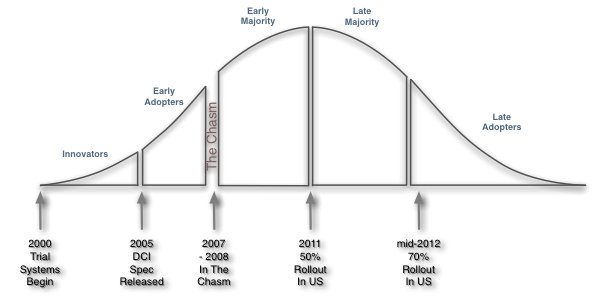
The classic technology adoption curve has proved useful in the past towards understanding the market environment for digital cinema, and it continues to illuminate why things are so. Our current version is shown below.
2012-adoption-curve-400

Digital Cinema Technology Adoption Curve

The US market, if not Europe as well, is in the late adopter stage. Manufacturers are selling to a different market than before. Today’s buyers are less in a rush to get the latest and greatest, and more concerned about what it will cost to own and operate. The concern is real, as nearly all exhibitors point to higher operating costs with digital projectors than with film projectors. As a result, Barco hands out sophisticated spreadsheets that allow buyers to compare cost of ownership based on published numbers. Christie advertises more efficient xenon lamps available only for its projectors. And Sony is introducing a smaller projector that uses low cost mercury lamps.

Laser illumination has a role here, too. However, laser illumination has several challenges noted in earlier reports, notably the metamerism problem, worldwide regulatory issues, and the economics of a technology with a high capex versus the high opex of standard xenon technology. Manufacturer estimates indicate that the average payback period for laser illuminators is around 8 years, which is likely to be higher than exhibitors are willing to bet on. Payback is achieved when the upfront capex for laser illumination equals the opex savings that occur by not using consumable xenon lamps and the power savings achieved through laser efficiency.

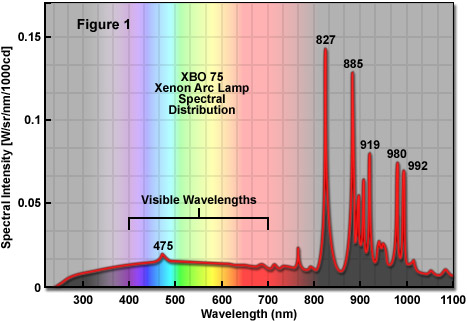
Of the technologies that are about to enter the market, Sony’s move to use mercury lamps is perhaps the most controversial. Mercury lamps are efficient with light, and multiple lamps are used, which allows the show to go on even when one lamp fails. The controversy, however, is that of spectrum. Pictures being worth 1000 words, we defer to the illustrations below. The first diagram shows the uniformity of spectrum offered by Xenon lamps.
xenonlampsfigure1

Xenon Spectral Distribution
(courtesy of Zeiss)

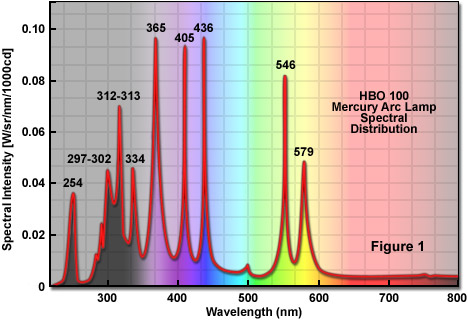
Mercury lamps, on the other hand, do not exhibit a spectrum that is anything near uniform, as can be seen below.
mercurylampsfigure1

High Pressure Mercury Vapor Arc-Discharge Spectral Distribution
(courtesy of Zeiss)

The fact that extensive filtering is necessary to flatten the mercury lamp spectrum is obvious. In a recent demo of a Sony prototype, this author observed both a yellow cast and a cyan cast, depending on light level, indicating that Sony still has some work to do. Competitors believe that once the spectrum is flattened, the efficiency of the lamps will be eliminated. While Sony has pulled rabbits out of hats before, solving this one may require some real magic.

Filed Under: Projectors Tagged With: Laser Projectors, Mercury Lamps

Primary Sidebar

Search

Topics

  • 3-D
  • Accessibility
  • Alt Content & Advertising
  • Anti-Piracy
  • Color
  • Communications
  • Deployment Entities
  • Distributors
  • Exhibitors
  • Fulfillment
  • High Dynamic Range
  • Higher Frame Rates
  • Installations
  • Patents
  • Projectors
  • Servers and IMBs
  • Sound
  • Technical Bodies
  • Theatre Management Systems
  • Trade Organizations and Shows

Full Archives

a publication of
MKPE Consulting LLC

Footer

Important Stuff

  • About
  • Privacy Policy

Archives

  • Category & Monthly Archives
Archives date back to 2008.

MKPE

mkpeReport is a publication of MKPE, a world-class consultancy building business at the crossroads of cinema and technology.
Learn more about MKPE.

copyright © 2008 - 2026 mkpe consulting llc

Manage Consent
To provide the best experiences, we use technologies like cookies to store and/or access device information. Consenting to these technologies will allow us to process data such as browsing behavior or unique IDs on this site. Not consenting or withdrawing consent, may adversely affect certain features and functions.
Functional Always active
The technical storage or access is strictly necessary for the legitimate purpose of enabling the use of a specific service explicitly requested by the subscriber or user, or for the sole purpose of carrying out the transmission of a communication over an electronic communications network.
Preferences
The technical storage or access is necessary for the legitimate purpose of storing preferences that are not requested by the subscriber or user.
Statistics
The technical storage or access that is used exclusively for statistical purposes. The technical storage or access that is used exclusively for anonymous statistical purposes. Without a subpoena, voluntary compliance on the part of your Internet Service Provider, or additional records from a third party, information stored or retrieved for this purpose alone cannot usually be used to identify you.
Marketing
The technical storage or access is required to create user profiles to send advertising, or to track the user on a website or across several websites for similar marketing purposes.
  • Manage options
  • Manage services
  • Manage {vendor_count} vendors
  • Read more about these purposes
View preferences
  • {title}
  • {title}
  • {title}